
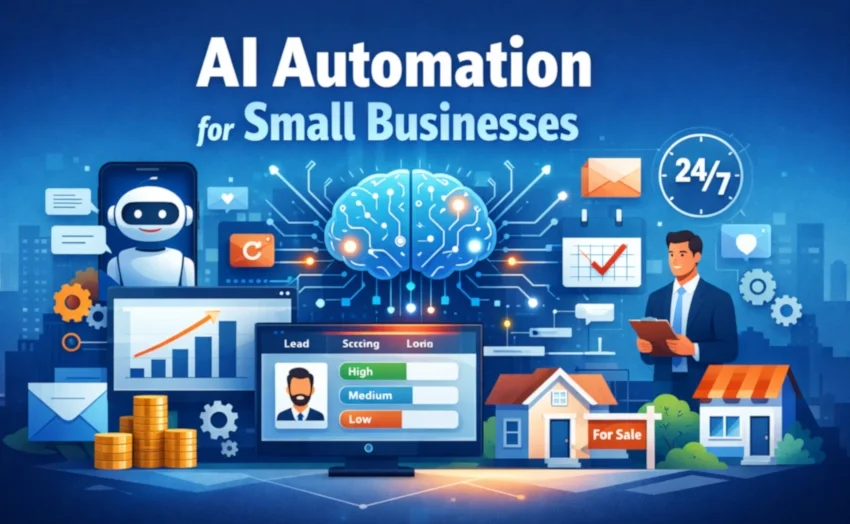
Small businesses today face a unique challenge: competing with larger organizations while operating with limited time, budgets, and manpower. This is where AI Automation for Small Businesses is becoming a game-changing solution. By automating repetitive tasks and enhancing decision-making, AI enables smaller companies to operate smarter, faster, and more efficiently—without increasing operational costs.
AI automation is no longer a luxury reserved for enterprises. It has evolved into an accessible, scalable solution that empowers small businesses to streamline operations, improve customer experience, and drive sustainable growth.
Understanding AI Automation in Simple Terms
AI automation combines artificial intelligence with automated workflows to handle tasks that traditionally require human effort. Unlike basic automation, AI-driven systems can analyze data, learn from patterns, and make intelligent decisions over time.
For small businesses, this means everyday processes—such as lead handling, customer support, scheduling, invoicing, and reporting—can run automatically with minimal supervision. The result is greater accuracy, faster execution, and better use of human talent.
Key Benefits of AI Automation for Small Businesses
1. Improved Operational Efficiency
One of the most immediate benefits of AI automation is efficiency. Tasks that once took hours can now be completed in seconds. Automated systems work continuously without breaks, ensuring business processes remain consistent and error-free.
Small teams can accomplish more without expanding staff, allowing business owners to focus on strategy rather than manual operations.
2. Cost Reduction Without Sacrificing Quality
Hiring and training employees for repetitive tasks can be expensive. AI automation reduces dependency on manual labor by handling routine activities such as data entry, follow-ups, and basic customer interactions.
By lowering operational costs while maintaining quality, AI automation helps small businesses improve profitability and reinvest savings into growth initiatives.
3. Smarter Decision-Making Through Data Insights
AI systems analyze large volumes of data in real time. They identify trends, patterns, and insights that are often missed by manual analysis.
With AI automation, small businesses gain access to actionable insights that support smarter decisions—whether it’s optimizing marketing campaigns, forecasting demand, or improving customer retention.
4. Enhanced Customer Experience
Customer expectations have changed. People now expect fast responses, personalized communication, and consistent service.
AI automation enables small businesses to respond instantly to inquiries, personalize interactions based on customer behavior, and provide support around the clock. This creates a seamless customer experience that builds trust and long-term loyalty.
5. Scalable Growth Without Operational Complexity
Growth often introduces complexity—more customers, more data, and more processes. AI automation ensures businesses can scale without overwhelming their teams.
Automated workflows adapt easily to increased demand, allowing small businesses to grow sustainably while maintaining service quality and operational control.
Practical Use Cases of AI Automation for Small Businesses
Automated Lead Management
AI automation captures leads from websites, ads, and messaging platforms, qualifies them based on behavior, and routes them to the right team or system instantly.
Intelligent Customer Support
AI-powered chatbots and virtual assistants handle common queries, resolve issues, and escalate complex cases only when needed.
Marketing Automation
AI optimizes email campaigns, ad targeting, and content delivery by analyzing engagement data and customer preferences.
Financial & Administrative Automation
Invoicing, expense tracking, payroll processing, and reporting can be automated to reduce errors and ensure compliance.
Overcoming Common Concerns About AI Automation
Many small business owners hesitate due to concerns about cost, complexity, or job displacement. However, modern AI automation solutions are designed to be user-friendly and cost-effective.
Rather than replacing employees, AI supports them—freeing staff from repetitive tasks so they can focus on creative, strategic, and customer-centric work.
Why AI Automation Is No Longer Optional
In today’s competitive market, efficiency and adaptability determine survival. Businesses that rely solely on manual processes risk falling behind faster, more agile competitors.
AI Automation for Small Businesses is not about adopting futuristic technology—it’s about staying relevant, resilient, and ready for growth.
Final Thoughts
AI automation has become a powerful equalizer for small businesses. It enables them to operate with enterprise-level efficiency while maintaining flexibility and control.
By embracing AI automation, small businesses can reduce costs, enhance customer experiences, make smarter decisions, and scale with confidence. Those who adopt early gain a competitive advantage—positioning themselves for long-term success in an increasingly digital economy.